The Path to AGI is a Network, Not a Monolith
The AI industry is currently obsessed with scale, operating under the assumption that the path to Artificial General Intelligence (AGI) is simply a bigger, more powerful model.…
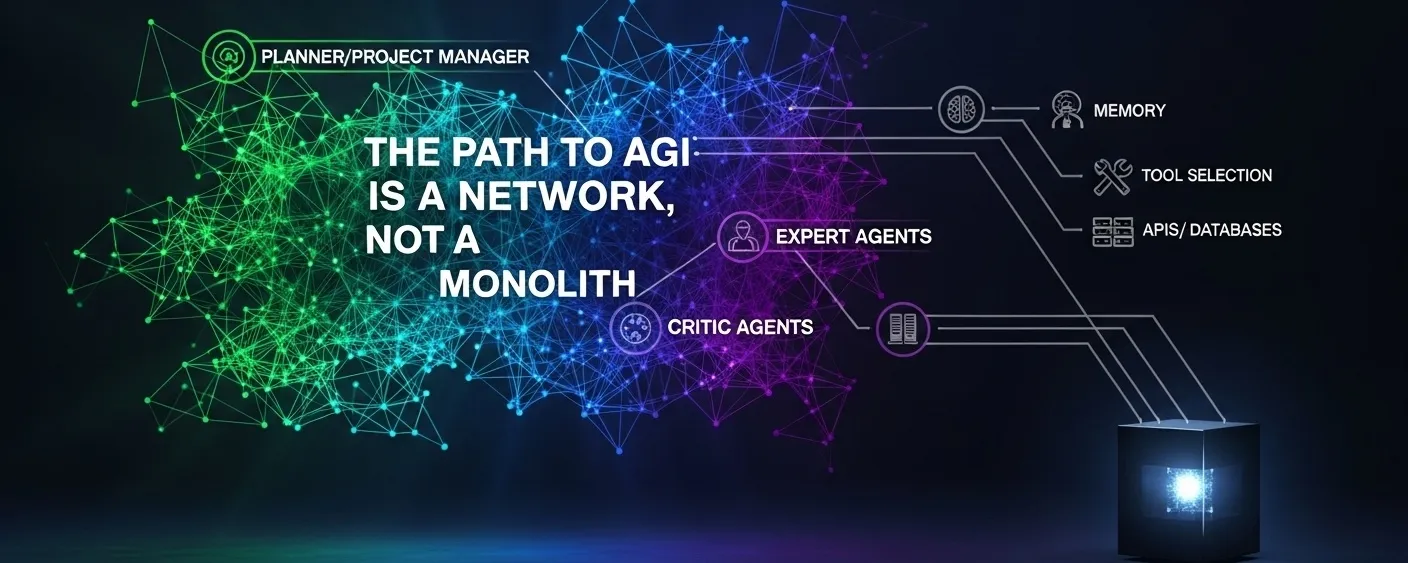
The AI industry is currently obsessed with scale, operating under the assumption that the path to Artificial General Intelligence (AGI) is simply a bigger, more powerful model. This is a fundamental architectural error. We are looking for a singular breakthrough, a monolithic consciousness, when in fact, true general intelligence will not be a product that is built, but an emergent property of a well-orchestrated network. The future of AI is not a monolith; it is a collaborative system.
The Brain: Our Blueprint for a Multi-Agent System
To understand why, we need only look at our own intelligence. Consider the simple, almost unconscious act of catching a ball. This is not a single, linear decision. It is a high-speed, parallel computation executed across highly specialized systems in the brain.
- Vision Processing: Recognizes the object and its trajectory.
- Motor Planning: Calculates the precise interception path for your limbs.
- Sensory Feedback: Adjusts your grip in real-time based on the feel of the object.
Each system is an expert at its distinct task. The remarkable intelligence of the action isn’t located in any single neural cluster, but in their seamless, high-speed coordination. Your brain is, for all intents and purposes, a multi-agent system. To expect a single, end-to-end Large Language Model (LLM) to replicate this integrated intelligence is a category error—it is akin to asking the visual cortex to also handle the intricate muscle control required for the catch.
The Architectural Flaw of Monolithic LLMs
Current LLMs are powerful language pattern matchers, but they operate as a single, undifferentiated process. They fundamentally lack the dedicated, independent sub-systems required for robust intelligence.
- No Internal Validation: They lack built-in mechanisms for self-correction or for validating their own intermediate steps.
- Linear Process: They are trapped in a linear thought process, making it difficult to dynamically plan, backtrack, or adapt their strategy mid-task.
- Tool Use as an Afterthought: While they can use tools, this capability is layered on top of the core language model, not integrated as a native function of a specialized system.
This isn’t merely a matter of scale that more data or parameters will eventually solve. The best human experts do not solve complex problems in a single, unbroken stream of consciousness. They externalize thought, break down problems, and validate their steps. They employ a system. For AI to achieve a similar level of capability, it must be architected to do the same.
Engineering Intelligence: The Roles within the Network
A robust Multi-Agent System (MAS) is not simply a group of chatbots. It is an orchestrated network of specialized agents, each with a distinct and vital role in the problem-solving process. At a minimum, such a system requires:
- A Planner or Project Manager Agent to deconstruct the primary goal into a logical sequence of sub-tasks.
- Expert Agents, each equipped with a specific set of tools (APIs, databases, specialized models) and the competency to execute its assigned sub-task.
- Critic Agents to validate the outputs of the Expert Agents against the initial constraints, objectives, and quality standards.
Within this architecture, memory and tool use become critical, integrated capabilities.
- Memory: Is not a standalone agent but a set of functionalities—fast access to vector stores, relational databases, or a dynamically updated context available to the entire network.
- Tool Selection: Becomes a core competency of the Expert Agents, guided by the Planner, which is essential in a world with an explosion of APIs and MCPs.
The OpenServ Approach: Architecting for Collaboration and Reliability
This is why our research and development at @OpenServAI focuses on the orchestration layer. Our Cognition Framework is built entirely around this multi-agent philosophy. We recognize that simply launching an agent is not enough; it must be supported by a system that enforces reliability and facilitates complex interactions.
For every primary agent executing a task on our platform, we run specialized shadow agents that form a Collaboration Layer. This layer serves as the agent’s connection to the broader system and the human user. Its key responsibilities include:
- Platform Interaction: Handling critical I/O tasks like file system operations and external API integrations.
- Autonomous Quality Assurance: Providing immediate, autonomous feedback via an integrated output validator agent, creating rapid correction loops to resolve issues before they require human intervention.
- Human-in-the-Loop Escalation: Orchestrating the feedback process for human guidance, correction, and final validation when autonomous correction is insufficient.
This Collaboration Layer, in conjunction with our Critic agents, provides the built-in correction and adaptation mechanism that monolithic LLMs inherently lack. They ensure the primary agent’s plan is sound and its output meets the required standards before it’s finalized, seamlessly incorporating human feedback where necessary. This isn’t about hoping for better reasoning from a base model; it’s about architecting a system that actively enforces it.
The future of AGI will not be found in a bigger black box. It will be engineered through thoughtful, distributed systems that orchestrate specialized agents, tools, and validation loops. The intelligence isn’t just in the agent; it is in the architecture of the network. This is the core belief that drives our work at OpenServ, as we build the platform for this emergent, collaborative intelligence to thrive.
Ultimately, this shift in perspective—from monolithic models to orchestrated networks—is not just an academic exercise; it is a necessary evolution for building AI we can trust with meaningful work. The challenge ahead lies in the art and science of this orchestration: designing the agents, defining their roles, and engineering the collaborative fabric that connects them. This is the frontier where the true potential of artificial intelligence will be unlocked, and it is the difficult, essential work we are committed to at OpenServ.
First published on X.